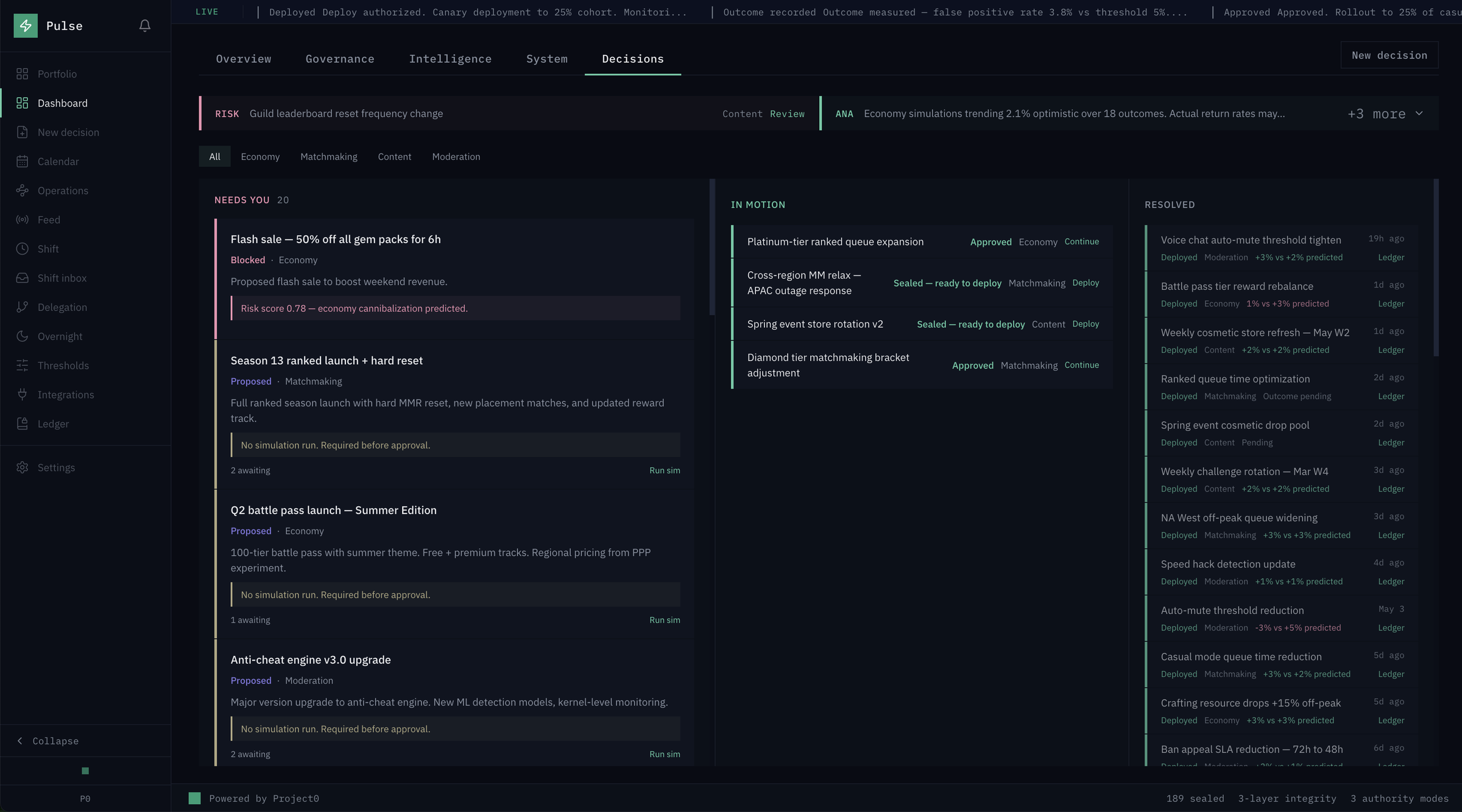
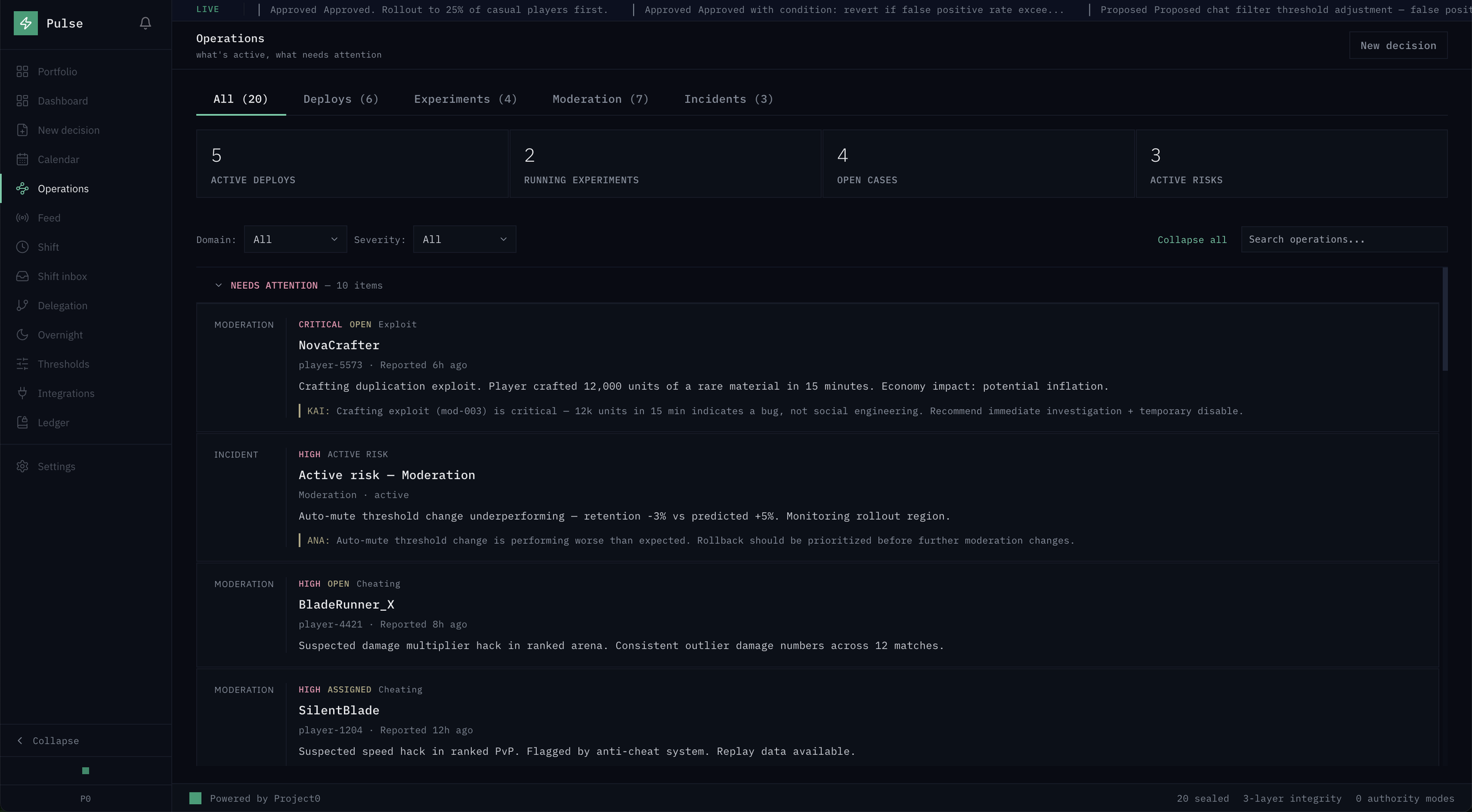
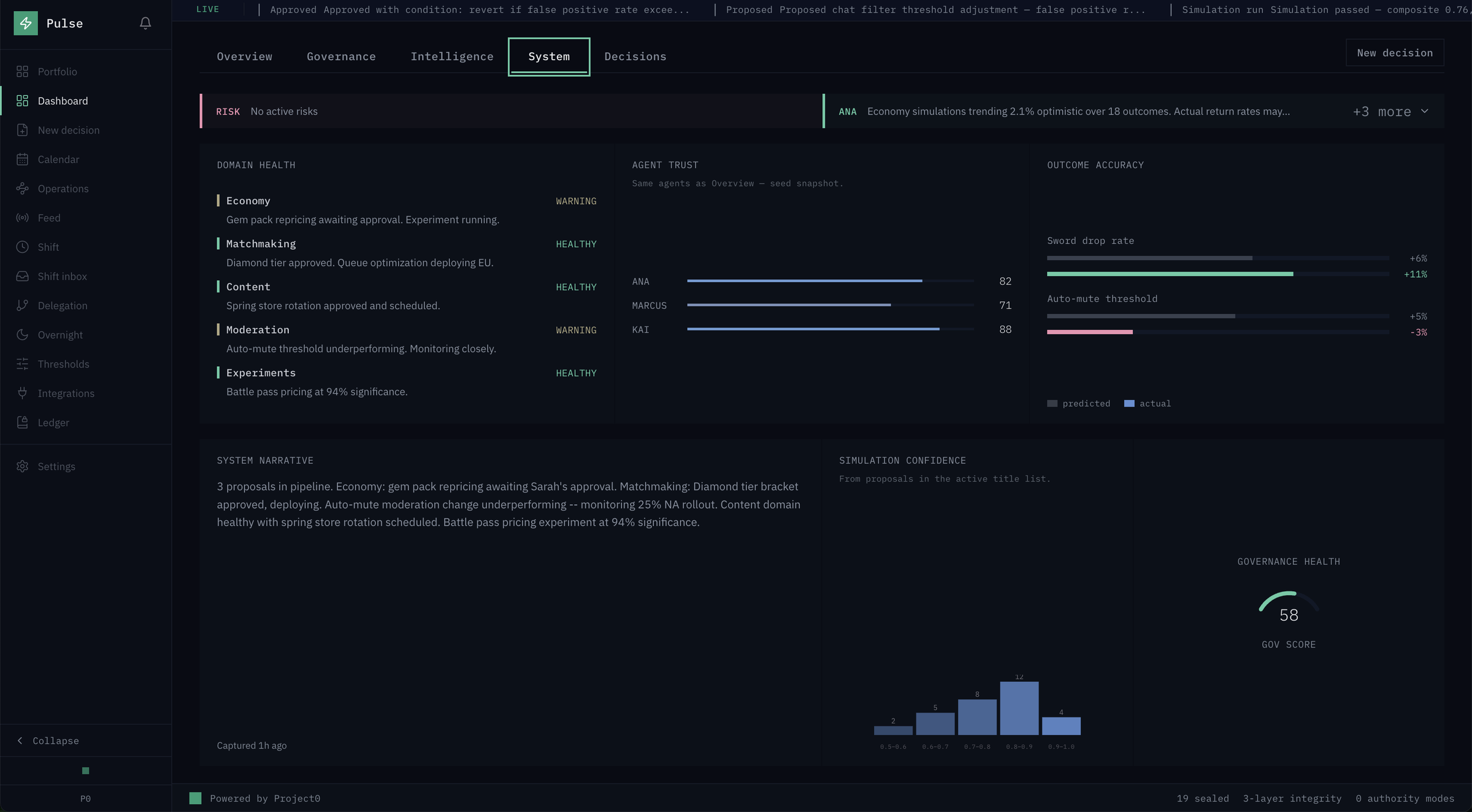
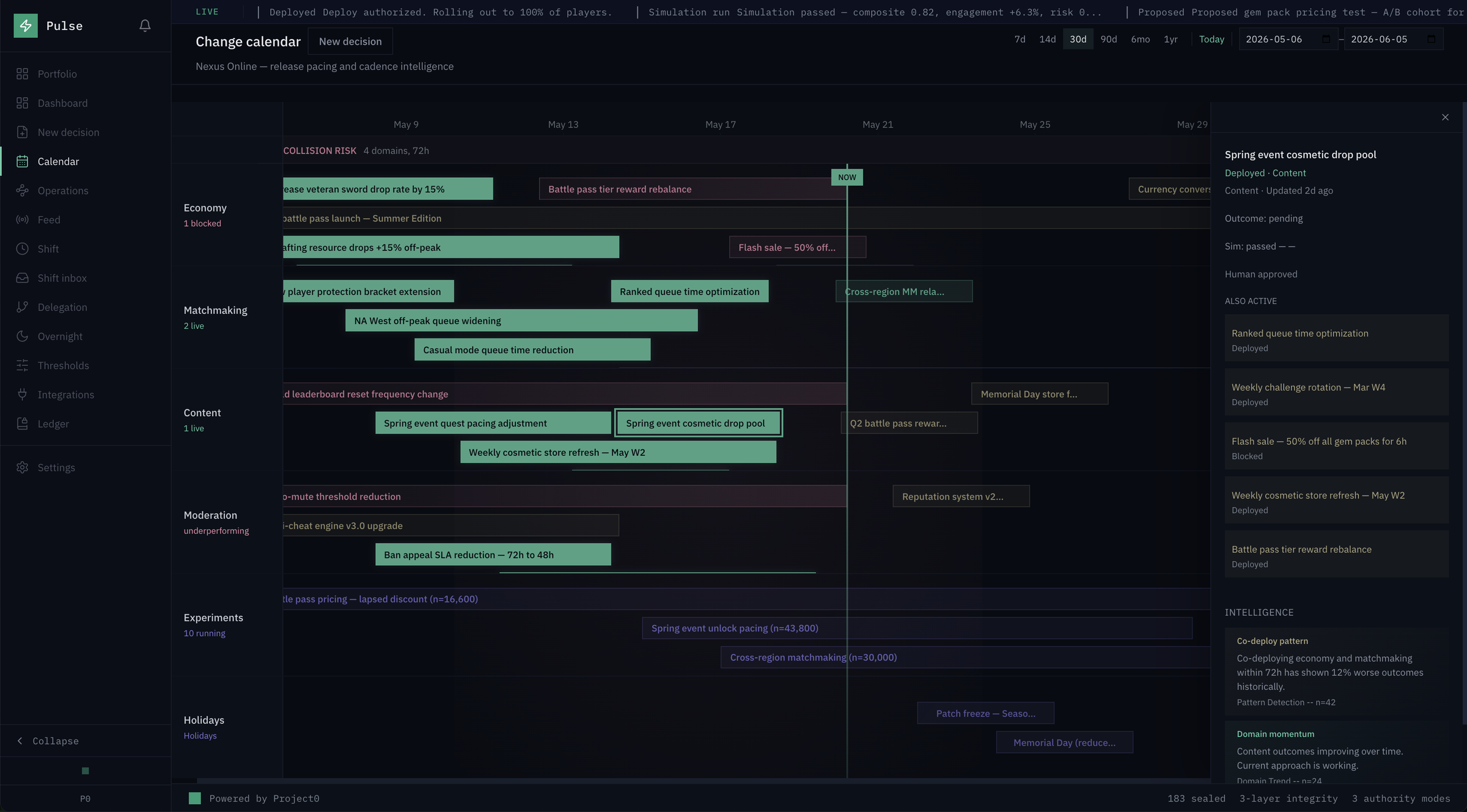
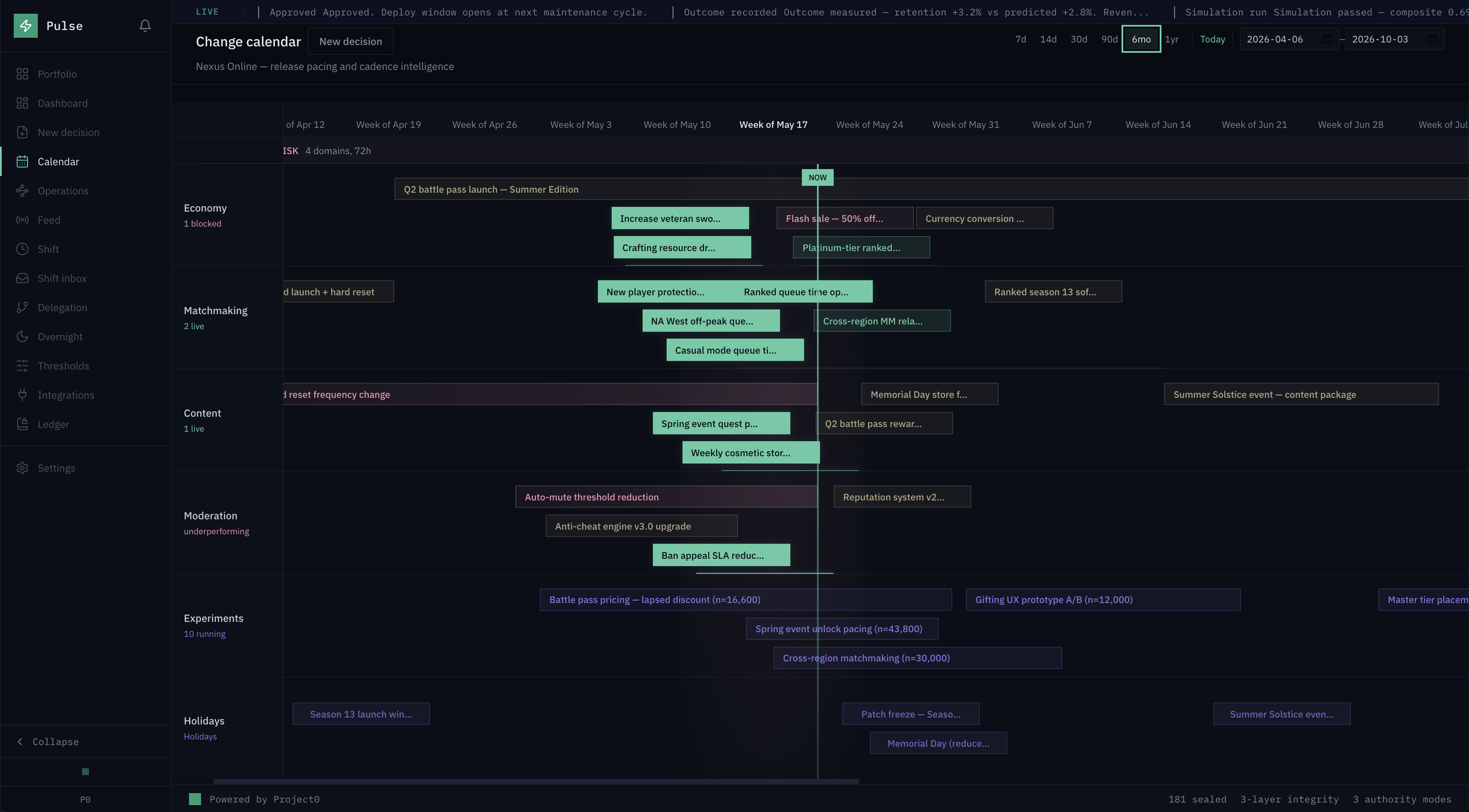
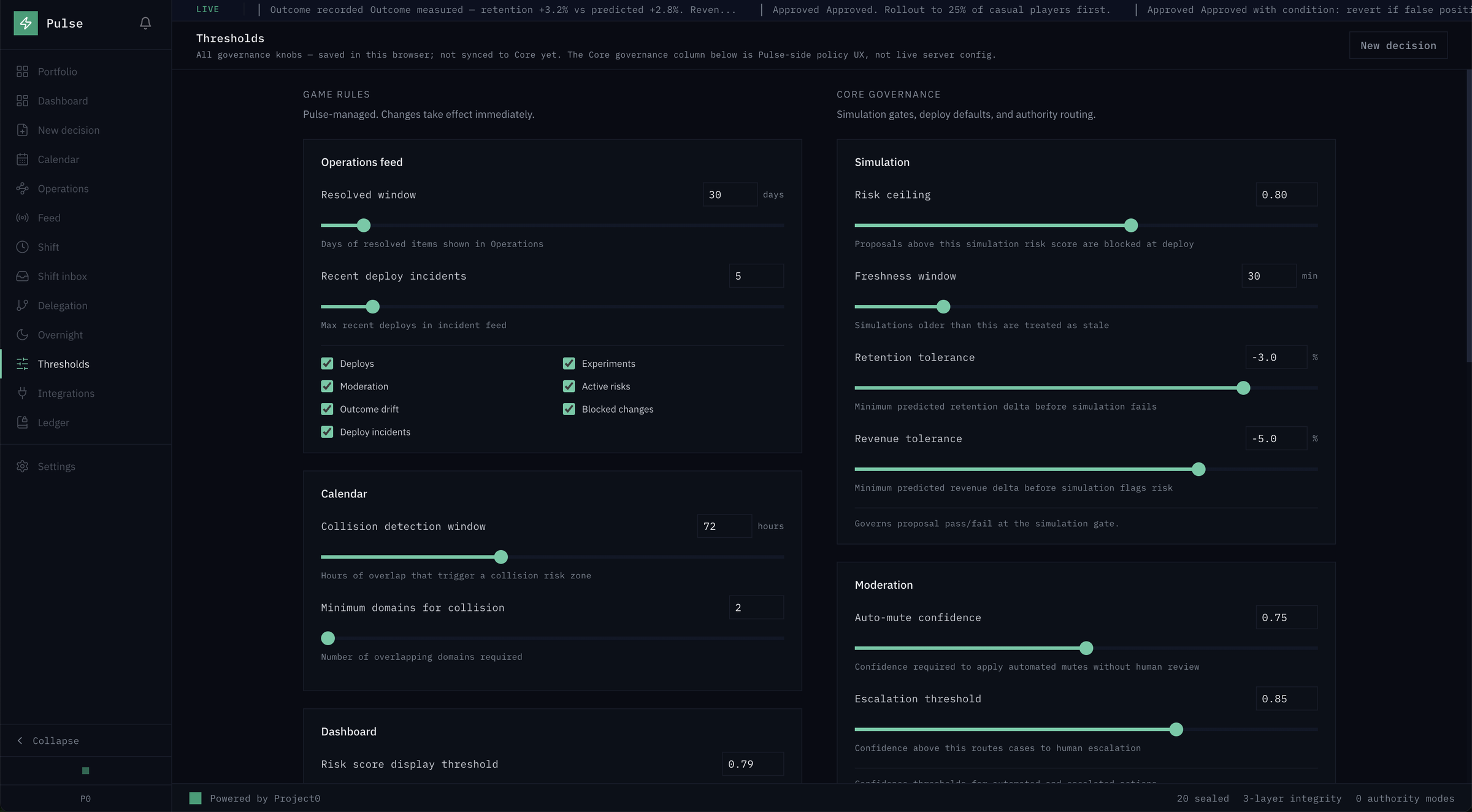
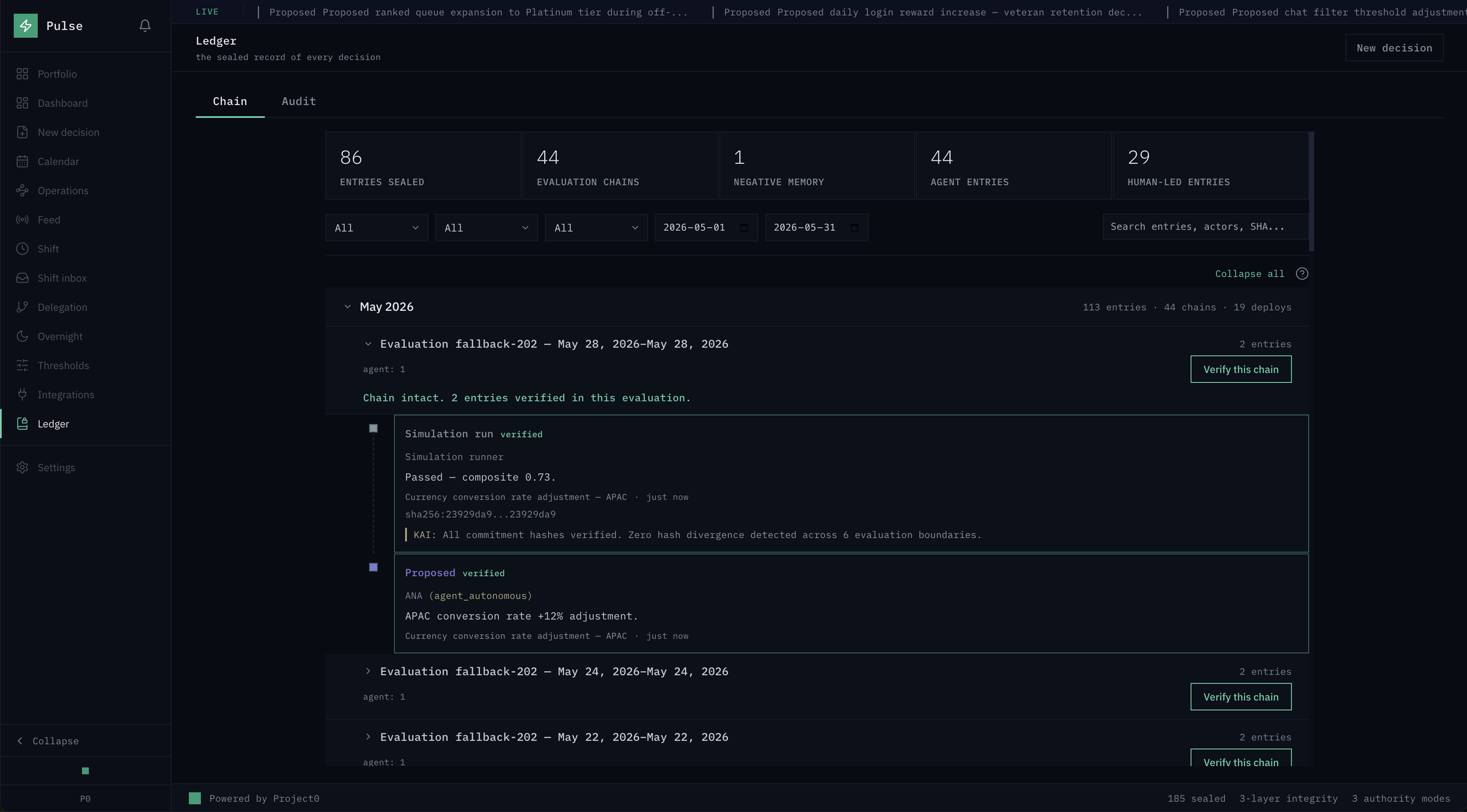
Pulse is the operator console your live team already wished lived next to the build. It attaches to Project0 Core so every economy, matchmaking, content, moderation, or emergency change moves through propose, simulate, approve, and deploy with plain language states, authority on the record, and exportable audit. You keep the people who know the game. You add a sealed system of record that still works when the incident is on Monday morning and the lead is on a flight.
Same team. Governed. More capable.
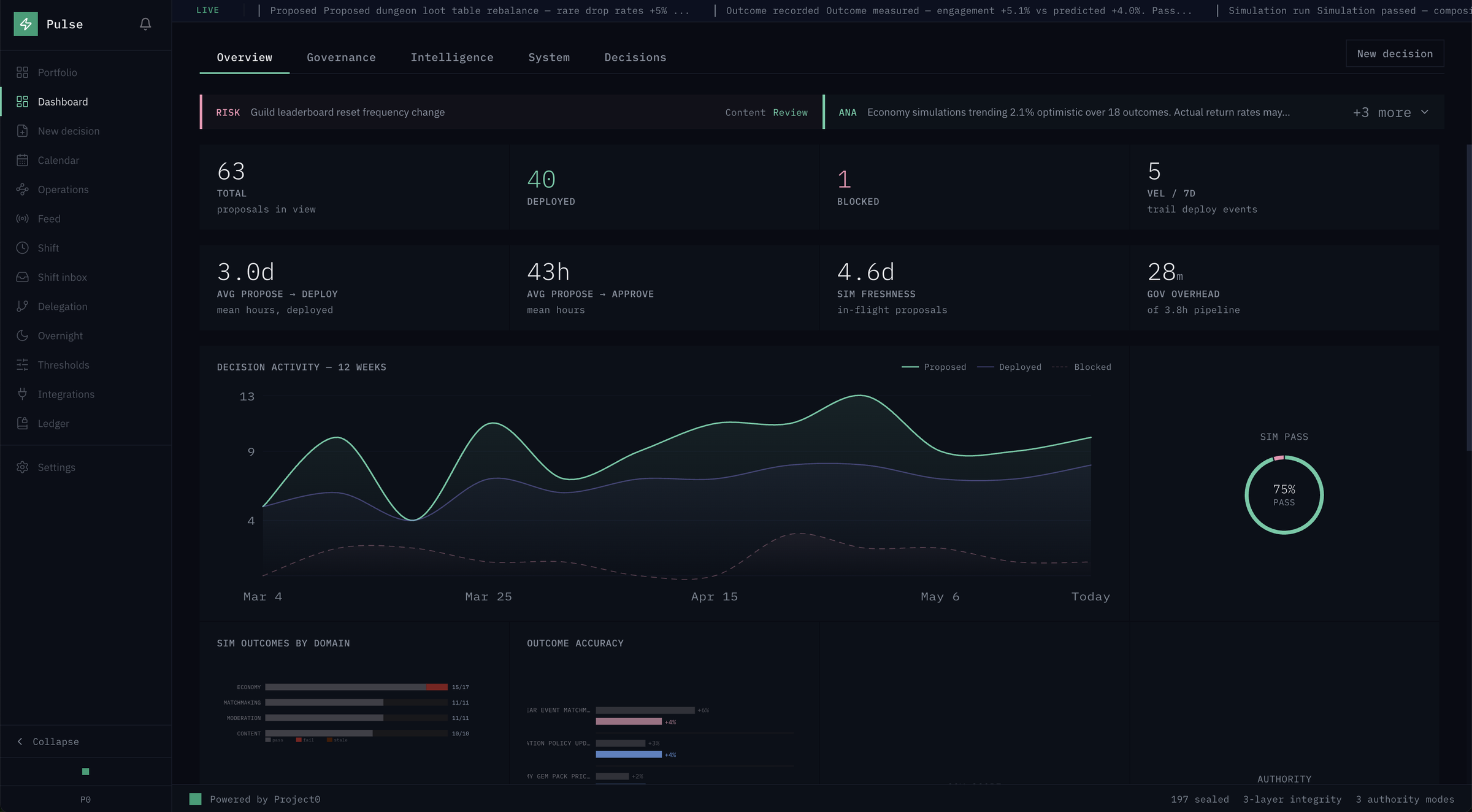
Pulse augments live operations, release coordination, and governance heavy producers. It does not replace your game client, your backend services, or your data science bench. Operators still choose what ships. Designers still own the intent. Executives still carry the brand risk. Pulse removes the tax of reconstructing decisions after the fact, and it blocks stale or mismatched simulations from slipping into deploy when your Core flags demand that discipline.
What it does not replace: creative direction, player community strategy, narrative voice, or the final human call on a risky change. What it replaces in practice is the shadow backlog of "who clicked ship" threads, the spreadsheet that pretends to be an audit log, and the junior engineer learning your API vocabulary by breaking production once.
Expect throughput you can defend. Expect faster onboarding because plainLanguage.ts style translations sit between Core states and the operator. Expect a buyer owned Next.js surface and BFF so keys stay server side, which matters the moment procurement asks where secrets live. Expect honest limits too: some dashboard risk cards still read from demo seed when Core is live until a risk stream lands, and audit rows can remain seeded while decisions are already Core backed. What you read here reflects what ships today, not a roadmap.
Concentration in PC and console markets is no longer a niche observation. Newzoo's PC and Console Gaming Report (data updated May 2024) states that PC and console gaming generated $94.0 billion in 2023 with plus 3.1 percent year over year growth, and that ninety percent of new game revenue in 2023 was captured by just forty three titles. The same report notes that in game spending accounted for forty three percent of PC and console revenues in 2023, which is another way to say recurring monetization and live operations are structurally load bearing, not a side mode.
When a handful of titles capture most incremental revenue, every other shipped game competes harder for retention time. Live service monetization is described in that report as tending toward a zero sum contest for time against other hits. Hiring alone does not fix that dynamic, because each new body adds coordination cost, access sprawl, and another inbox that still lacks a cryptographic trail when legal asks what happened at 2 a.m.
Pulse is timely because the economic pressure moved from "ship once" to "prove how you ship forever." Operators need capacity without losing defensibility. A governed console that sits on Project0 Core turns repeated live changes into a reviewable object, which is closer to what finance, platform partners, and your own post mortems already ask for.
Sources. Newzoo, PC and Console Gaming Report 2024 (consumer revenue and concentration statistics, updated May 2024): newzoo.com/resources/trend-reports/pc-console-gaming-report-2024 and the companion PDF hosted on Newzoo resources.
Specific capacity numbers depend on your actual workflow mix, how many changes per week touch economy versus moderation, and how strict your simulation gates are in production. The magnitude is what we model together with your telemetry and staffing plan. Directionally, teams should see value when leads stop rebuilding timelines by hand and when juniors stop decoding raw error enums during an outage.
Illustrative only. Uses United States compensation benchmarks for software roles and common hiring friction assumptions. Your geography and total rewards package will move these bands.
Comp reference. U.S. Bureau of Labor Statistics Occupational Outlook Handbook entry for Software Developers, Quality Assurance Analysts, and Testers, median annual wage for software developers $133,080 in May 2024: bls.gov/ooh/computer-and-information-technology/software-developers.htm
The cost of augmentation is usually a fraction of the cost of hiring for the same coverage. The exact delta depends on your title count, change velocity, existing Core footprint, and whether you license or acquire. We want to model this with your real inputs, not a generic SaaS calculator.
This is not headcount reduction. This is upgrading what humans do while the sealed record catches up automatically.
You move at your own speed.
Your data does not train our models
Project0 does not use your production decisions or player payloads to train public models as part of this product story. Final contractual language follows your paper.
Your data stays in your control
Core hosts the Ledger and gaming APIs you configure. Pulse is a client plus BFF. You choose regions and retention in line with your cloud agreements.
Deletion is real
Operational deletes follow your Core and cloud retention policy. Append only Ledger semantics mean historic decisions are tamper evident by design, which is different from silent erase.
Sub processor transparency
You see the same vendors your enterprise team already uses when Core runs on your cloud project, and we enumerate processors in diligence.
Access your systems without authorization
No mystery agents inside your VPC. Integration is explicit keys, explicit routes, explicit operator identities.
Make decisions without human approval
Deploy and approve buttons sit behind your authority model. Agents run inside declared authority modes.
Lock you in
Acquisition path is designed so the Next.js app and MCP are portable. Engine coupling is concentrated in the server Core client and BFF proxy for a bounded migration if you choose port instead of keep Core.
Compete with your game
We sell governance infrastructure, not a competing consumer title.
Pilot length should land between thirty and sixty days on a single production or high fidelity staging title. A full engagement typically runs about eighteen months under a Founding Partner style agreement so we can sequence gate enforcement, artifact verification expectations, and any custom connectors with your roadmap. Founding Partner pricing is conversation based and should reflect whether you license Pulse with Core, acquire the console stack, or bundle multiple Project0 surfaces.
Integration load assumes a small number of focused engineering hours per week while the BFF, Firebase verification path, and Core admin key rotation are aligned. Operators ramp faster than new hires because the UI already speaks their vocabulary when GREENLIGHT_DEMO_MODE is used for training, then flips off for live reads.
Pulse is built on Project0 infrastructure.
Project0. From nothing, create something.